Evo
The Evo has had a fairly substantial amount of work done over the last 2 years, and I’m still sorting out all of the upgrades that were made. I don’t like to change a lot between racing the car, but with how scheduling has been, it was fairly inevitable. I’m back on track now, and I’ve still got a few more updates coming. A lot of what I’ve done have their own posts, but a lump of work is just coming in now:
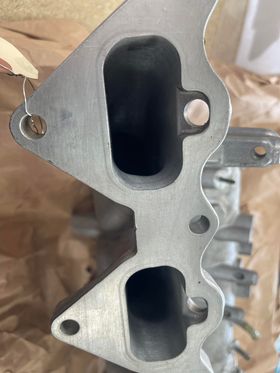
- Ported intake manifold – Boostin Performance – Using JDM map sensor & OEM intake gasket
- Somewhat of a, while we’re here modification, I am having a stock intake manifold for the 9 ported for better flow. It’s not too restrictive, and indeed may not do much of anything at my power and boost levels, but with a flex tune tweak coming up, seemed like a good option for me to add. Even for stock turbo levels though, there should be a small amount of gain as air will flow more smoothly, revving better, spooling a hair quicker, and gaining a small amount of power.
- https://shop.boostinperformance.com/boostin-performance-ported-stock-intake-manifold-evo-8-9/
- 3″ Maperformance OEM Fitment Downpipe with flex joint
- During the flex tune, one of the things that we were suspecting was that the exhaust was a little too restrictive for the desired performance of the car. I was thinking about this for a bit, and realized the most likely source was my downpipe, which is a 70mm (2.75″) Tanabe. Aside from the exhaust manifold, which I had ported and coated by Strictly Modified years ago, and the various mufflers and resonators (which don’t really restrict the exhaust flow), this is the only area in the exhaust that necks down to under 3″.
- The MAP OE fitment downpipe is a pretty beautiful piece of kit. It’s a hand TIG welded piece, with mandrel bent SS tubing with, crucially, a flex joint. This flex joint, which I currently do not have, will provide useful flexibility given the stresses even the exhaust sees during track racing. It’s possible too, that this downpipe caused the phantom knock I’ve seen on this car since owning it. As the name implies, it also reuses stock gaskets, bolts, etc. so I have purchased new bolts etc. to use.
- https://www.maperformance.com/products/maperformance-oem-fitment-downpipe-2003-2006-mitsubishi-evo-8-9-map-evo-dp
- FP Race Exhaust Manifold
- As it turned out, my long (probably ~12 year old) ported and coated stock exhaust manifold warped, causing an exhaust leak. It’s possible a few of these little issues I’ve battled were due to the exhaust, and I think the flex joint in the The worst possible timing, and without going big $, I went with FP’s race manifold. I’m a little nervous, as oftentimes these parts are not as good as stock. I’m hoping though, that this part will be at least as good as stock. FP’s official description:
- The FP manifold for the EVO4-9 features 20% larger runners and collector entry angles that would make a tubular header blush. It is constructed from a durable, high temperature alloy that resists cracking and is compatible with the factory heat shield. In house testing results show lower exhaust pressure in the collector area and increase in total system mass flow at the same boost pressure – translation: more power for you!
- https://www.forcedperformance.shop/products/fp-evo-4-9-race-manifold
- Mid-muffler
- Replacing my resonator is possibly the largest muffler I’ve tried fitting in the middle/cat part of the exhaust – this is a 5″ round 14″ body length magnaflow muffler, with flanges welded on each end of the exhaust. I have heard that this makes the tone of the exhaust lower, rather than actually making it quieter, but I’m sure on my car it will do both. Has to do more than a resonated downpipe (I still have other resonators), and maybe even a cat also. Clears with decent room to spare.
- Magnaflow 12867 (5″ round center/center, 14″ body length) & 2 Stainless Bros flanges
- OEM knock sensor
- My car, pre-and post-new motor, has always flashed a couple random counts of knock here and there, especially around spoolup. It’s been sporadic, but has caught the tuner’s eye. I think there are a number of things it could be. When the engine failed, they suspected some random vacuum line causing an issue, but I think there was also a combination of oil and fuel starve.
- The point of that comment is that it’s unlikely we’ve got an issue with the motor itself. If anything, I suspect the downpipe somehow rattling intermittently. Regardless, we want to eliminate any variables, and a bad knock sensor, though rare, is one of the factors we want to eliminate.
- MR578117
- OEM gas cap
- I’ve noticed for a bit that I’ve had some slight fuel leakage coming from my gas cap area. I assumed in the past it was related to me not filling up as “cleanly” as possible, encountering some leaks from time to time.
- Alex’s Automotive was able to spot that it was actually the gasket in the gas cap causing actual leakage/seeping, so I ordered a new gas cap.
- I’m interested in the implications that arise from a loose/not tightly sealing gas cap. Obviously, I’m losing very small amounts of fuel, but that matters still. It clearly comes all the way to the top of the fill tube and out of it, so it must be quite turbulent. That is also going to have implications for the fuel pressure and the fuel pump, so it’s no wonder some cars will throw a CEL if it detects the gas cap is not tight. In any case, a small, cheap, and necessary fix.
- MIT-1711A015
- New AFR gauge
- My wideband gauge is old – very, very old. Almost as old as my boost gauge, but technology has moved on for wideband technology, and the MTX-L is one of the best ones out there, operating much, much quicker than mine. This gauge reads much quicker from the sensor, providing real time AFR – ultimately providing a safer tune, better response, and ability to catch a bad AFR reading quicker, which could be crucial to the life of the motor. Plus, my old one recently lost a side of the number 4, which is the most frequent number shown
- https://www.maperformance.com/products/innovative-motorsports-mx-l-digital-wideband-afr-gauge-3918?variant=38065833539


Sequoia
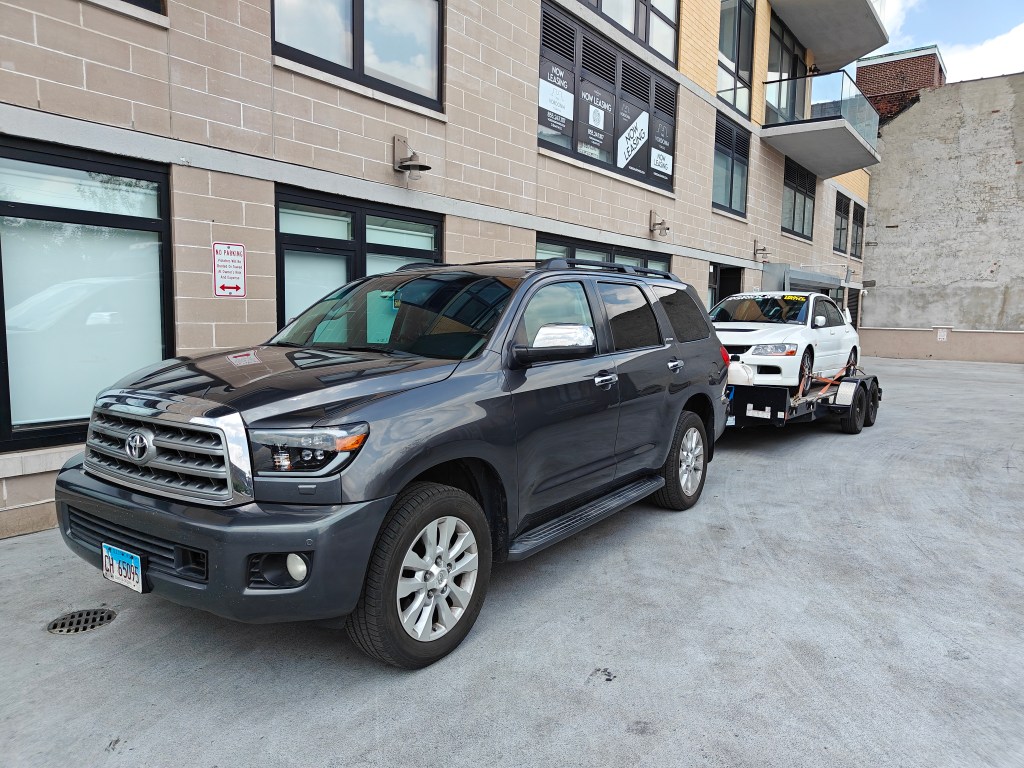
Not a ton of changes for the Sequoia; continued maintenance is the name of the game. This is the kind of car where the gear oil and other fluids sit for the life of the car, so I’m comfortable in not flushing any of those fluids again for a while, as all of those fluids were flushed around 223k miles, which is when I first got the car. The Sequoia now has around 262k miles, so nearly 40k miles driven in ~2 1/2 years, mostly from towing). I’m still really loving the car, and its tenure has outlasted most of the other “side cars” to the Evo. All that said, we still had a few upgrades to the Sequoia – namely, a new Optima Yellowtop battery & the Alpharex headlights. I’ve also in the past had a few things fixed, some of which have and some of which have not been mentioned in the build: new shocks f/r, new rear air springs, sway bars, major timing chain overhaul service (March of 2021, ~230k miles where they also flushed coolant & did the spark plugs). New calipers were also done in the front and rear around when the pads were done.
I’ve also had to do a number of fixes from a towing incident I had a couple years ago, which resulted in some cosmetic damage to the trunk. I had to replace the handle immediately after it happened, but around the start of the year, the trunk latch stopped working properly, in a strange way. It didn’t feel like it was closing properly, more like it was hitched on the pre-close latch portion. After hitting large bumps, I would get the warning that the trunk lid was open, meaning the latch wasn’t fully closed down. The process to fix this issue, which I did in May of this year, was a relatively simple one. I ordered the latch/controller unit from Amazon. This was only $80 bucks at the time of purchase. I wasn’t entirely certain it would actually fix the problem, but I figured it was worth a shot given the delership wanted $180 just to do the diagnosis. It turned out that it was indeed the problem; the old controller was corroded so badly that the locking mechanism was simply frozen in place. The auto open & close of the trunk hadn’t been working proerply for some time, so I guess this has been on its way out for a while now. In any case, I opened the trunk, removed the surrounding trim and the door panel itself, and was able to finagle out the old controller and finagle in the new one. Perfect swap, perfect fitment, and I greased the latch to help prevent corrosion in the future. The one thing I did notice was that the closing/releasing mechanism did not work properly until I disconnected and reconnected the battery, at which point I think the trunk ECU reset itself and worked. I put everything back together, and have reclaimed the ability to remote open and close the trunk, to my great relief. It’s still got a lot of towing work ahead of itself, so this is a great feature to have, with the car again back to stock-levels of full functionality.


 QL Motorsport & Car Journal
Thank you for the updates, glad I caught up with what you’ve been doing.